Beef Quality Assurance Cattle Injection Triangle
Injection Sites
· 1995 Beef Quality Audit reported 11 percent of carcasses had at least one injection site blemish
· The best site to requite an injection isn't always the near convenient
· Proceed all injections in front of the shoulder
· Injection technique for both SC and IM injections
· Never inject more 10cc into one site
· Don't re-inject into injection sites
· Minimize the risk of injection site reactions
The 1995 National Beef Quality Audit revealed 11 percent of the carcasses surveyed had at to the lowest degree ane injection site blemish. The beef industry loses about $7.05 for each fed heifer or steer marketed due to injection site lesions. Not just can the injection site get out visible lesions, but there are also significant tenderness problems associated with lesion-afflicted lean tissue.
The recommended site for injections is non ever the well-nigh convenient or easiest site to attain. The all-time location for an injection is the site where the product is the most benign, without the take chances of damaging the more expensive cuts of meat (upper rump and upper barrel).
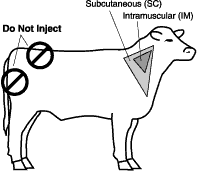
The 1995 National Beefiness Quality Audit suggests direction changes to decrease the incidence of injection site lesions and reactions. First, producers should motion the location of injection sites from the top barrel and round to the neck, equally shown in Figure five, and use subcutaneous administration where the label allows. Producers should besides discard burred or aptitude needles rather than reusing them. Figure five. Proper injection location.
Producers should pay detail attention to preparing their calves' allowed systems through vaccinating. Programs that emphasize the importance of calf diet and timing of vaccinations tin significantly reduce both the incidence of treatment (and usually injection) for respiratory affliction and the incidence of excesses of multiple vaccinations, which can increase the incidence of injection site lesions.
Producers should pay particular attention to preparing their calves' immune systems through vaccinating. Programs that emphasize the importance of calf nutrition and timing of vaccinations tin can significantly reduce both the incidence of treatment (and commonly injection) for respiratory disease and the incidence of excesses of multiple vaccinations, which can increase the incidence of injection site lesions.
To reduce lost value of the expensive cuts of meat, keep all injections in front of the shoulder. NEVER INJECT INTO THE TOP Butt OR Pinnacle OF THE RUMP!
For both vaccines and antibiotics, the triangular mass of cervix musculus is the preferred site for both IM and SC injections. Exist certain to inject straight in, not at an angle, when giving IM injections. Use the tenting method for SC injections.
Never inject more than 10 cc into i site. When making multiple injections, keep injection sites at least five inches autonomously, being careful non to reuse injection sites. To minimize the adventure of infection and incidence of injection site lesions, avert injecting into wet or manure covered areas.
Administering Injections Properly
Steps in Administering Injections Properly
- Select the right production
- Read the label
- Don't combine vaccines
- Utilise transfer needles
- Don't mix too many products
- Keep shaking
- Mark and separate syringes
- Don't use disinfectants with modified alive vaccines
- Go air out of syringes
- Restrain animals properly
- Select best route of assistants
- Choose best site of administration
- Choose the right needle
- Employ proper injection technique
- Practise good sanitation
- Select the right product
When giving vaccinations; select the right product for your need. This product should prevent futures infections or aid in stopping the current infection. Once a product is selected, follow the characterization instructions.
- Read the label
The label of all health products will include 1) the dosage to be given, ii) the timing of assistants, and iii) the route of administration. The most common routes of assistants are intramuscular (IM), subcutaneous (SC), intravenous (Four), intranasal (IN), and topical. Other less common methods are intramammary (IM), intrauterine (IA), intrarumenal (IR), and oral. The label volition listing warnings, indications for use, and withdrawal times if any. The characterization will also include proper methods of storage and disposal and expiration date.
- Don't combine vaccines
Mixing unlike vaccines could destroy the effectiveness and value of the private products. Use only approved combinations.
- Utilize transfer needles
Apply transfer needles if a product needs to exist reconstituted. The use of transfer needles should make the process easier and more sanitary. To employ a transfer needle, place one end of the needle into the sterile liquid or dilutant; the other terminate goes into the freeze-stale cake of vaccine or bacterin. In that location should be a vacuum in the freeze-stale portion that immediately pulls the dilutent down.
- Don't mix as well much of a product at one time
Modified alive vaccines (MLV) begin to dethrone, or lose effectiveness, after well-nigh an hour. Mixing too much production at one fourth dimension may decrease effectiveness. For maximum effectiveness, mix enough vaccine for but 1 hour or less. Direct sunlight and extreme temperatures will also degrade the production, so it is best to keep information technology in a dark cool place, similar a cooler. Don't save leftover vaccine for afterward use. Information technology won't be effective and could be contaminated. Dispose of all vaccine bottles and equipment properly.
- Proceed shaking
When using large, multi-dose sizes of vaccine, such as a 200-dose bottle, mix thoroughly at first, and then stop from time to time and shake the bottle once again. If yous don't keep mixing, the vaccine may settle, giving an inconsistent amount of antigen in each injection.
- Mark and split up syringes
Use and marking different syringes for bacterins or killed products. Marker the MLV syringes and keep them separate from the others. If traces of bacterin are left in a syringe that is later used for a modified live product, the bacterin could destroy the modified alive vaccine, making it ineffective.
- Don't utilise disinfectants with MLV
Don't clean syringes used for MLV with disinfectants. Apply hot h2o to clean these syringes. Disinfectants can destroy MLV that you later put in the same syringe. A mild disinfectant can be used for cleaning bacterin syringes, but exist sure to rinse thoroughly.
- Get air out of syringes
To assistance get the correct dose of vaccine in the animal, remove whatsoever air that may be trapped in the syringe by pumping the grip slightly before filling. After filling, pump information technology enough to move the vaccine upward to the needle tip and then there is no trapped air that might be injected with the vaccine.
- Restrain animals properly
Restraining animals properly reduces the potential of hurting the brute or yourself. Proper restraint can reduce the level of bruising to the animal. Bruising alone costs the cattle industry $22 million per year.
- Select the best route of administration
Selecting the best route of administration is crucial to constructive vaccination. The ii most common routes of administration are intramuscular (IM), which means injecting into the musculus, and subcutaneous (SC), which means injecting under the skin. Some products offer a choice, while others must be given in a specific way. The label volition country the best method of administration. Generally, bacterins or killed products tin be given SC. Modified live virus products are usually given intramuscularly, because this allows the virus to reproduce and achieve the lymphatic system more hands. Whenever possible, apply the subcutaneous route if allowed on the characterization.
- Choose the best site of administration
Injection site lesions price the industry about $7 per creature slaughtered. The best injection site is not necessarily the 1 that's the fastest or the easiest to get to. It is the site where the product will be the about effective, with the least possible gamble of damage to valuable cuts of meat. Give all injections in the neck. Never inject into the top butt or height of the rump.
- Apply the correct needle
Choosing the correct needle may also lessen injection site lesions. When administering SC injections, use a 16 or xviii-gauge needle, ½ to ¾ inch long. For IM injections, use a 16 or xviii-gauge needle 1 to one½ inch long, every bit shown in the table below. A 14-gauge needle isn't recommended - it is twice the diameter of a 16-approximate, which increases the take chances of leakback and tissue damage.
If a needle is aptitude or cleaved, discard and supplant with a new needle. Bent and broken needles increment the number of injection site lesions and increase the gamble of broken needles entering the nutrient supply.
- Use proper injection technique
When giving SubQ injections; tent the skin to get the product just under the skin and not into the muscle. Pull the skin away from the animal's body and insert the needle into the fold of pare. When giving multiple injections, continue injection sites several inches autonomously. Don't administer more than 10 cc of production into whatsoever one site. If a production must be given several times over a period of a few days, vary the injection site.
- Proper sanitation is essential
Good sanitation practices reduce the risk of spreading infection from one brute to some other, the take chances of contaminating the vaccine, and injection site reactions. Some basic steps to good sanitation include not going back into the vaccine bottle with the same needle y'all use to vaccinate. Alter needles frequently, at least every 10 to 15 animals, or every syringe of vaccine. When using killed vaccines, continue a saucer or sponge of alcohol or disinfectant nearby and wipe off the needle after each use. Do non disinfect needles betwixt injections when using a modified live vaccine, as the disinfectant can destroy the vaccine. Injecting into a wet or muddy site can increase both the spread of disease and the incidence of injection site lesions. Make sure the injection site is clean. Clean transfer needles regularly to avoid contamination.
Right Needle Size
Subcutaneous Intramuscular
½ to ¾ inch needle 1 to one ½ inch needle
Cattle Weight Cattle weight
Injection Viscosity <300 300-700 >700 <300 300-700 >700
Thin (needle gauge) eighteen eighteen-16 16 20-18 xviii-xvi eighteen-sixteen
Ex: Saline
Thick (needle gauge) 18-16 xviii-xvi sixteen 18 xvi 16
Ex: Oxytetracycline
Source: https://www.ag.ndsu.edu/bqa/documents/injections
0 Response to "Beef Quality Assurance Cattle Injection Triangle"
Post a Comment